
By Julia
Darjeeling, India
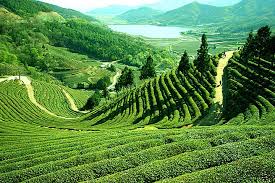
We have now entered the “breathtakingly beautiful” portion of our trip, I thought as our jeep winded its way up the incredibly steep mountain road leading up to Darjeeling. We were surrounded on all sides by sharply sloped, emerald-green hills. Some were carpeted with ancient forest, others carefully cultivated into clusters of tea plantations or cascades of rice paddies. Small houses with delicately carved wooden doors perched precariously on the edges of the road, many using stilts to balance the back half of the house over the cliffs. With every switchback, the space between the guardrail-less road and valley floor grew greater. The driving was as nerve-racking as the scenery was beautiful.
Luckily, we were in good hands. Tendup, the on-site coordinator of a volunteer program I work with through EnRoute, had offered to take us to a few villages as part of my site visit. I’m planning several of these visits throughout our trip to learn more about the organizations I partner with and the work they are doing on the ground. Tendup planned a 2 day itinerary for us that included a lot of walking, meeting and eating.
 |
| Hiking from Pacheok |
 |
| Traditional Nepali dance |
 |
| Schoolchildren at St. Joespeh's - Please note girl second from right |
The volunteer program focuses on aiding the Lepcha community, an indigenous population that has resided in the mountains of what is now Sikkim, India, Bhutan, and Nepal for hundreds of years. Volunteers live and work in the villages as teachers, bringing much needed resources to an area that has been largely ignored by the Indian government. As the crow flies, the villages are relatively close to one another and the closest town, Kalimpong. But, “as the human drives” it can take hours to get from one place to another due to the winding, pot-holed, monsoon-ravaged mountain roads.
The first village we visited, Pacheok, is accessible only by foot path leading into the pristine, hilly forest. We were joined by two ex-volunteers, who were coincidentally revisiting their homestay family at the time of our visit. A horde of excited village children greeted our jeep at the end of the paved road. The children were elated to see their teachers again, and to meet Tom and I. They grabbed our things, insisting we carry nothing, and led us across an Indian-Jones style swinging footbridge that shook with the thuds of eager feet. Admittedly, I felt as if we had entered an entirely different India as I hiked past the unspoilt waterfalls and noted the damp silence of the woods.
 |
| Our village host in Pacheok |
 |
| Tendup relaxing by candlelight |
After a quick rest at our village accommodation, Tendup announced that our presence was requested at the nearby school. The ex-volunteers, Tom and I made our way in the twilight to a small building busting at the seams with villagers, mostly schoolchildren. The kids preformed a few traditional Lepchas songs and dances and sang a few songs in English as well. Part of the welcoming ceremony included the children draping white scarves over our shoulders and yelling “Aachuley!” which translates to “Hail to the Himalayas!”. Then, much to my surprise and delight, Tom and I were presented with traditional gifts. I received a silk dumden, the customary dress of Lepcha women, while Tom was presented a formalwear hat. “They give and give. It’s their way,” one of the volunteers explained.
The following day was spent trekking to two other villages and visiting a few more schools. At each location we were showered with white scarves and necklaces of flowers, presented with dances and fed delicious food. The schools ranged from a corrugated tin one-room schoolhouse on a ridge to a private school run by a benevolent Christian reverend. Tom and I were honored to be escorted all day by Lyangsong Tamsang, a man the locals deemed “King of the Lepchas” for his extensive work preserving the Lepchas language and culture. I had really wanted to befriend a king on this trip, so we can cross that off the list!
 |
| Group shot at St. Joeseph's, King of Lepchas in center |
Although this visit was technically work, I had a blast. It was amazing to get off the beaten path and experience a vibrant culture few people get to see first-hand. I loved talking to the children about their imported teachers and the impact they have on the students’ lives. It was refreshing to hear Lyangsong explain the nature-based philosophy of the Lepchas, which helped explain the trashless paths and lovely gardens surrounding the homes in the villages. “We’re naturalists,” he explained. “We are bound to nature and respect it. Any of the children you saw today can name all the plants on these hills. It is our way of life.”




No comments:
Post a Comment